
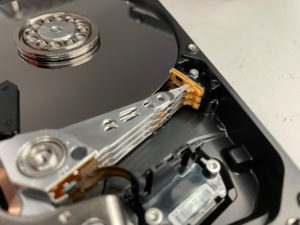
The read/write heads of a hard drive in a resting position.
Head parking ramps are small, static plastic guides located near the outer edge of a hard disk drive (HDD) platter that provide a safe resting area for the read/write heads when the drive is powered down or idle.
By physically lifting and holding the heads away from the magnetic surface, head parking ramps prevent accidental contact that could lead to data loss or catastrophic platter damage.
(This little bit of engineering is one of the main reasons why the “freezer trick” is unlikely to result in a successful data recovery, by the way; learn why you should never freeze your hard drive).
Today, we’ll explore how these components function, why they are superior to older landing zone technologies, and how they factor into professional data recovery.
How Hard Drives Work: A Quick Overview
Inside a hard drive, the read/write heads are mounted on the tip of an actuator arm. During operation, these heads fly on a microscopic cushion of air generated by the spinning platters.
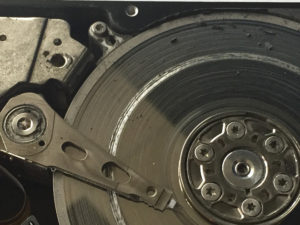
This hard drive shows rough platter damage where the head remained in contact with the platters for several hours of operation.
When the drive loses power or receives a command to enter standby mode, the actuator arm must move the heads to a safe position immediately. Otherwise, you’ve got a head crash — and that means instant data loss.
To prevent this, the arm swings toward the outer perimeter of the drive, and small tabs on the suspension (the tip of the arm) slide onto the angled surface of the parking ramp. As the tabs slide up the ramp, the heads are lifted vertically away from the platter surface.
Evolution from Landing Zones to Parking Ramps
Earlier hard drive designs did not use ramps. Instead, they utilized a method called Contact Start/Stop (CSS). In CSS drives, the heads would land on a specifically textured area of the platter near the spindle, known as the landing zone.
CSS drives had significant vulnerabilities. If the drive sat idle for too long or if the lubricant on the platter degraded, the heads could physically bond to the landing zone. In our labs, we frequently encountered older drives that had seized up simply because the heads had adhered to the surface — a phenomenon technically known as stiction.
Parking ramps solve this problem by ensuring the heads never touch the recording media, regardless of whether the drive is spinning or stationary. This design improvement offers several advantages:
- Increased Shock Resistance: Because the heads are locked onto a plastic ramp rather than sitting on the platter, the drive is much less likely to suffer damage if moved or jostled while powered off.
- Smoother Spin-Up: The motor does not need to overcome the friction of the heads resting on the surface in order to start spinning, which reduces wear on the motor bearings.
- Greater Platter Density: Manufacturers can utilize the entire surface of the platter for data storage. They don’t need to reserve space for a landing zone.
Unfortunately, no data storage device is perfect. Parking ramps reduce the chances of rotational damage when mechanical components fail, but head crashes can still cause permanent data loss under the right (or wrong) circumstances.
Potential Issues with Hard Drive Head Parking Ramps
Parking ramps are simple components, but they can be involved in severe mechanical failures. A significant physical shock — for example, physically dropping a hard drive while it’s operating — can cause the actuator arm to bounce and make contact with the platters.
We frequently see cases where the heads impact the ramp with enough force to snap the plastic. When plastic debris is scattered inside the drive, the heads may become stuck between the broken ramp and the platter.
Note: If you hear a buzzing or clicking noise from your hard drive, do not attempt to open the drive casing. The tolerance between the heads and the platters is microscopic. Opening the drive outside of a cleanroom introduces dust particles that can destroy your data.
Data Recovery Technology: Addressing Ramp-Related Failures
Recovering data from a drive with a damaged parking ramp or stuck heads requires specialized tools. Professional data recovery engineers must open the drive in a cleanroom to assess the damage; if the heads are stuck on the platters (off the ramp), engineers use dedicated tools to lift the heads safely and guide them back onto the ramp or a donor assembly.
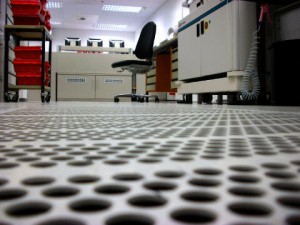
A data recovery clean room.
Forcefully dragging the heads back to the ramp without these tools usually results in severe rotational scoring on the platters; platter damage means permanent data loss. It’s also important to note that without a professional diagnosis, you cannot know whether a hard drive’s parking ramps are damaged — or whether other components require repair.
At Datarecovery.com, we utilize purpose-built hardware and ISO-certified cleanrooms to safely address mechanical failures. Our no data, no charge guarantee ensures that you only pay if we recover what you need.
If you suspect your hard drive has suffered a mechanical failure, contact us today at 1-800-237-4200 or submit a case online for a free evaluation.


