
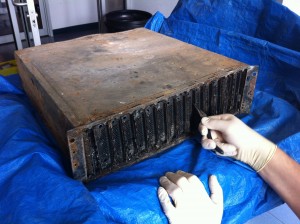
Our engineer removing a hard drive from a fire-damaged RAID.
While RAID 6 offers higher fault tolerance than RAID 5, its error correction system creates unique challenges when multiple drives fail or a controller malfunction occurs. Successful data recovery requires correct identification of the parity rotation and the exact point of desynchronization between the remaining disks.
Below, we’ll explain some of the basics of RAID 6 data recovery. For a risk-free evaluation or to speak with an expert, call 1-800-237-4200 or submit a case online.
RAID 6 Data Recovery Vs. Other RAID Levels
A standard RAID 5 array utilizes a single parity block (P) distributed across the member disks, allowing the system to survive the failure of one drive. RAID 6 expands on this by adding a second layer of parity (Q), which enables the array to remain operational even if two drives fail simultaneously.
Most RAID 6 implementations use Reed-Solomon encoding for the Q parity. While the P parity is typically a simple XOR (Exclusive OR) operation, the Q parity involves Galois Field algebra.
Thanks to that complexity, recovery engineers can technically reconstruct missing information even when the array’s metadata is partially corrupted, provided they can reverse-engineer the specific implementation used by the RAID controller.
Key architectural components of RAID 6 include:
- Stripe Width: The total number of blocks across all disks in a single row.
- Parity Schemes: The specific algorithms used to calculate P and Q blocks.
- Rotation Patterns: The sequence in which data and parity move from one disk to the next as the array grows (e.g., Left-Symmetric).
- Stripe Size: The amount of data written to a single disk before moving to the next one in the stripe.
When sourcing data recovery services, it’s helpful to collect as much information about the RAID 6 failure as possible — including information about any failed rebuild attempts.
Challenges in the RAID 6 Data Recovery Process
The primary obstacle in RAID 6 recovery isn’t the failed hardware, but rather the logic used to stripe the data across the drives. Every controller manufacturer uses a different parity rotation, stripe size, and offset, and proprietary configurations are common.
Identifying Parity Rotation and Delay
Before we can extract any files, we must determine the rotation scheme. This refers to the order in which data and parity blocks are placed on each disk (such as Left Asynchronous or Right Synchronous). If the rotation is misidentified, the data will appear as garbage, because the file pointers will be pointing to parity blocks instead of actual data.
Dealing with Stale Data
One of the most dangerous scenarios in RAID 6 recovery involves a stale drive. If a drive fails and the array continues to run in a degraded state for weeks before a second drive fails, that first drive contains stale data. Forcing that drive back into the array during a manual rebuild will result in massive file system corruption.
In our labs, we often see cases where a user attempted a forced rebuild, unknowingly mixing old and new data blocks and making the recovery much more difficult.
Remember that RAID is not backup; if a RAID fails with the only copy of mission-critical data, treat the situation as a data loss event. Do not attempt a rebuild without guidance from a professional data recovery provider.
Reverse-Engineering Controller Logic
Because the Q parity utilizes complex polynomial math, we must often write custom scripts to simulate the specific controller’s logic. If the physical controller is dead and the metadata is lost, we have to brute force the parameters by analyzing the underlying hex data to find patterns that match known file headers.
RAID 6 Data Recovery Prognosis
Despite these challenges, most RAID 6 data recovery cases have an excellent outlook. Because there are two parity blocks, we have a redundant mathematical path to the data. If a block of P parity is unreadable due to media damage, we can often use the Q parity to calculate the missing data.
A systematic approach ensures the highest probability of a successful file system restoration. Steps involved in a professional RAID 6 recovery include:
- Physical Imaging: Creating exact, bit-for-bit clones of every member drive to prevent further wear on original hardware.
- Parity Analysis: Determining whether the P and Q blocks are consistent across the stripes.
- Stripe Reconstruction: Manually aligning the data blocks in the correct sequence to mirror the original volume.
- Virtual Mounting: Emulating the array in a virtual environment to verify the integrity of the file system structure.
- Data Extraction: Copying the verified files to a secure, stable target drive.
Expert Assistance for RAID Data Recovery
At Datarecovery.com, we specialize in high-capacity enterprise storage and complex RAID configurations. We utilize purpose-built hardware and proprietary software tools developed in our own laboratories to ensure high success rates, even for proprietary and legacy systems.
With a comprehensive no data, no charge guarantee and risk-free standard evaluations, Datarecovery.com provides excellent resources for RAID 6 recovery and repair. Flexible service options (including 24/7 emergency services) help you restore your system on your schedule.
If you’re dealing with a RAID 6 failure, we’re here to help. Open a ticket online or call us at 1-800-237-4200 to speak with a recovery specialist.


