
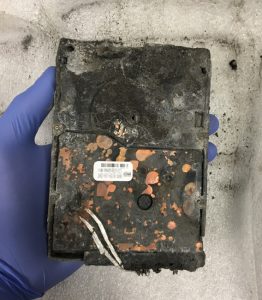
A fire-damaged hard drive.
Most hard drives are designed to withstand non-operating temperatures up to 158°F (70°C). A house fire can easily exceed this limit — but even if a hard drive is no longer functional, it may still be recoverable.
The physical chassis of a hard drive usually protects the data-storing platters. If the internal platters remain physically intact and haven’t reached a specific thermal threshold, the prognosis for data recovery is fairly good.
If you have a fire-damaged device, do not attempt to power it on. Contact Datarecovery.com at 1-800-237-4200 to discuss recovery options with an engineer or open a ticket online.
Hard Drive Fire Recovery: The Curie Point
According to the National Institute of Standards and Technology (NIST), temperatures in a typical house fire can reach 1,100°F at the ceiling level within minutes.
Modern hard drives use aluminum or glass platters coated in a thin layer of magnetic material. While aluminum melts at approximately 1,221°F, data loss typically occurs at the Curie point — the temperature at which a material loses its permanent magnetic properties.
For most magnetic storage media, this point is higher than the ambient heat of many structural fires. That means the magnetic orientation of your files often remains intact even if the external plastics have melted.
Unfortunately, heat isn’t the only factor to consider.
Fire-Damaged Hard Drives: Smoke and Soot Contamination
Fires produce environmental contaminants. When plastics and chemicals combust, they create soot, which tends to be corrosive.
Contrary to popular belief, hard drives aren’t perfectly airtight — they’re ventilated through a small breathing hole with a carbon filter. Microscopic particles can bypass the drive’s defenses.
If soot enters the Head Disk Assembly (HDA), it acts as an abrasive. If you attempt to power on a fire-damaged drive, the read/write heads will catch on those particles and physically scrape the magnetic film off the platters (check out the image on the right side of this page to see what that looks like in action). 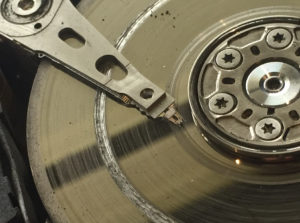
As a result, fire-damage hard drive data recovery must be performed in a certified cleanroom. Additionally, water used to extinguish the fire introduces minerals that cause rapid oxidation. If a drive has been sprayed or submerged, it’s vital to keep it damp rather than letting it dry out, which can bake contaminants onto the surface.
RAID Data Recovery After a Fire
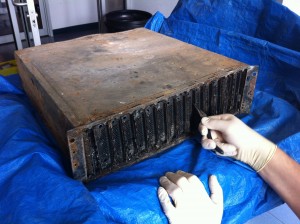
Our engineer removing a hard drive from a fire-damaged RAID.
When a fire involves larger storage systems, the recovery variables multiply. In data recovery for fire-damaged RAID servers, engineers must contend with multiple failed units. The heat often affects drives unequally; a drive in the center of a rack may be shielded, while an outer drive bears more of the thermal load.
Because RAID controllers frequently fail during a fire, the recovery process involves imaging each individual disk and virtually rebuilding the array. Seeing what a fire-damaged hard drive looks like can be discouraging, but as long as the platters haven’t reached the point of thermal deformation, the chance of a successful file restoration remains high.
Is Data Recovery Covered by Homeowner’s Insurance?
Most standard homeowner’s insurance policies cover the replacement cost of physical hardware — like your laptop or external drive — under personal property protection. Coverage for the recovery of the data itself varies significantly between providers and individual policies.
You should contact your insurance agent to discuss your specific situation, as some policies include clauses for data processing media or valuable papers and records.
Data Loss Prevention: Professional Recovery Options
If you’re dealing with a drive that’s been through a fire, your priority is to prevent further damage. Follow these steps:
- Do not apply power. Never attempt to test a fire-damaged hard drive or server. Soot and heat-warped components can cause an immediate head crash and permanent data loss.
- Do not clean the device. Wiping away soot or using cleaning chemicals can introduce new contaminants into the drive’s internal assembly.
- Keep the drive in its current state. If the device is wet, don’t dry it out. Place it in a sealed plastic bag to prevent contaminants from drying and baking onto the platter surfaces.
- Seek professional intervention. Fire-damaged media must be stabilized and treated within a certified Class 100 cleanroom to safely remove particulates before the imaging process begins.
If you’ve lost data to a fire, we’re here to help. Our engineers specialize in restoring files from fire-damaged RAID arrays, hard drives, and SSDs. With decades of experience, industry-leading technology, and real laboratories at every location, Datarecovery.com provides expert resources for data recovery following house fires and business disasters.
Call us today at 1-800-237-4200 or start a case online.


