

 For any law firm, the sudden loss of a case file or the failure of a centralized document management system is a crisis. When a partner’s workstation won’t boot or a server array is degraded, your immediate concern is integrity: maintaining attorney-client privilege, meeting filing deadlines, and protecting evidence.
We understand that legal data requires a level of care that goes beyond simple file restoration. Datarecovery.com’s engineers have decades of experience and have served law firms of all sizes, providing both electronic discovery (e-discovery) and traditional data recovery services with a strong emphasis on integrity.
To that end, we follow the security standards of the legal profession while following a careful process. Unlike some providers, we operate full laboratories at every location; we do not operate mailing offices, which introduce a potential chain of custody concern.
Below, we’ll explain some of the factors that law firms should consider when choosing a data recovery provider. For a risk-free media evaluation and a consultation with a data recovery expert, call 1-800-237-4200 or submit a ticket online.
Data Recovery, Computer Forensics, and E-Discovery: Understanding the Differences
Before sending hard drives and other storage media to a service provider, it’s important to understand the services that they offer and how they might impact data from a legal perspective.
This is particularly important when the target data contains potential evidence. Data recovery focuses on the mechanical or logical repair of storage media to regain access to lost files. E-discovery is the systematic identification, collection, and preservation of electronically stored information (ESI) for use as evidence.
In our labs, we’ve seen IT service providers inadvertently jeopardize a litigation strategy by treating an evidentiary drive as a standard recovery ticket. Attempting to verify files on a drive, for example, will alter last-accessed timestamps, which can lead to chain of custody challenges in court.
Because treating an e-discovery case as a simple data recovery project can lead to sanctions or the dismissal of evidence, it’s important to define your objectives before any engineering work begins.
If your target data may contain potential evidence, tell your service provider immediately. That allows for appropriate chain of custody procedures and documentation.
Law Firm Data Restoration: Preserving Data Integrity
Data loss carries a unique set of risks for the legal sector, ranging from lost billable hours to potential malpractice exposure.
- According to the IBM Cost of a Data Breach Report 2025, the average cost of a data breach in the United States has reached $10.22 million.
- The American Bar Association (ABA) 2023 Legal Technology Survey indicated that 29% of law firms have experienced some form of security breach.
Legal environments are defined by complex encryption, massive document management systems (DMS), and strict regulatory silos. Those can present some concerns for data recovery providers:
- Multi-Layered Encryption: Most law firms employ at-rest encryption on laptops and servers (like BitLocker or FileVault). Recovering data from a failed SSD that is encrypted requires physical data recovery along with the precise reconstruction of the encryption headers.
- Database-Driven Environments: Legal work often lives inside specialized databases such as iManage, NetDocuments, or Relativity. A standard file-level recovery may successfully retrieve the database files, but if the internal pointers are corrupted during the crash, the entire index of case files may be inaccessible. Professional recovery requires a deep understanding of SQL and specialized database structures to ensure the data is usable upon return.
- Metadata Recovery: In litigation, a document’s metadata (its creation date, author, and revision history) may be more valuable than the contents of that file. Standard data recovery tools may strip this metadata or replace it with the date of the recovery attempt. For firms, this can lead to claims of spoliation.
Preserving Legal Data Following a Media Failure
When a storage device fails, the actions taken in the first few minutes determine the likelihood of a successful result. We suggest following a broad strategic plan to maintain data integrity while restoring the affected systems:
- Cease Operation Immediately: Disconnect the device from its power source. Continued operation risks permanent data loss.
- Isolate the Media: Remove the drive or server volume from the production environment to prevent automatic background processes (like indexing or antivirus scans) from overwriting deleted data.
- Evaluate Backup Status: Verify the integrity of your off-site or cloud backups.
Note: Using consumer-grade “undelete” software on a physically failing hard drive often causes a total mechanical collapse, rendering the data permanently unrecoverable.
Storage Media We Handle for Law Firms
Our laboratory is equipped to handle the diverse range of storage formats found in modern legal practices, from high-speed arrays to cold-storage archives. We maintain extensive hardware libraries and dedicated tools to treat every storage device, including:
- Hard Drives and SSDs: Mechanical drives from workstations and solid-state drives from laptops.
- RAID and Servers: Complex multi-drive arrays, including NAS, SAN, and virtualized server environments.
- Encrypted Media: Secure extraction for drives protected by BitLocker, FileVault, or hardware-level encryption.
- Data Tapes: Professional recovery for high-capacity tapes including LTO (from early generations to current LTO-8 and LTO-9 standards), DLT, SDLT, AIT, DDS/DAT, and Exabyte.
- Mobile Devices: Smartphones and tablets used by firm personnel or involved in forensic discovery.
Why Law Firms Choose Datarecovery.com
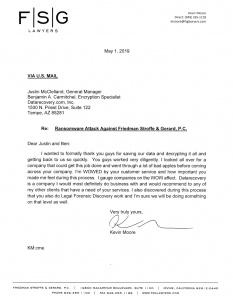
Security and procedural reliability are the core tenets of our service. We utilize purpose-built, isolated systems to ensure that sensitive client data is never exposed to external networks during the recovery process.
Our laboratories offer risk-free evaluations for most tickets and operate under a no data, no charge guarantee for data recovery tickets: your firm only pays a recovery fee if we successfully retrieve the specific files you need. We bring that same security and technical expertise to privileged information, and we handle it with discretion.
To begin a ticket for a free evaluation or to discuss forensic chain of custody protocols, submit your ticket details online or call 1-800-237-4200.