
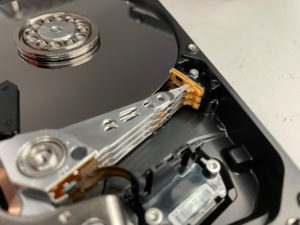
In the process of a data recovery evaluation, you might hear that your device has stiction.
Stiction occurs when the read/write heads of a storage device become physically stuck to the data storage media. That prevents it from reading or writing data. It’s only possible with storage media that has moving components (such as hard drives and data tapes).
In most cases, stiction is caused by a failure of the lubricant layer on the media or environmental factors like high humidity. Because the motor cannot overcome the friction to spin the platters or move the tape, the device becomes inaccessible — and professional intervention is necessary.
Below, we’ll explain more about stiction. If you’re not interested in the technical details, here’s the most important takeaway: Physical media damage must be treated by trained data recovery professionals in a certified cleanroom. We
We provide risk-free evaluations and support all cases with a no data, no charge guarantee: If we’re unable to get the files you need, there’s no charge for the attempt. Call 1-800-237-4200 to speak with an expert or submit a case online.
What Is Hard Drive Stiction?
To understand stiction in a hard disk drive (HDD), you first need to visualize how the drive operates during normal use. In a healthy HDD, the read/write heads fly on a microscopic cushion of air just nanometers above the spinning platters — a distance much, much thinner than a human hair.
Key aspects of hard drive stiction:
- Parking Failures: When you power the drive down, the heads should move to a designated landing zone or a plastic ramp. If they stop over the data area instead, they can become stuck.
- Surface Tension: Both the platters and the sliders are incredibly smooth. Static friction and surface tension — exacerbated by moisture or degraded lubricant — can literally glue the heads to the disk.
- Motor Resistance: When you try to power the drive on, you might hear a faint humming or a repetitive beeping sound as the motor tries and fails to spin the stuck assembly.
Modern hard drives have safeguards to prevent stiction, which is why it’s a fairly rare occurrence. We should also note here that the infamous “freezer trick” was once a treatment for hard drive stiction — but that’s no longer the case, and putting your drive into a freezer (or oven) will significantly lower your chances of a successful recovery.
Related: The Hard Drive Freezer Trick: Debunking the Oldest Data Recovery Myth
Stiction in Magnetic Tape Media
While the term is most commonly associated with hard drives, stiction also poses a significant threat to legacy tape formats like LTO, DLT, or consumer VHS and audio tapes. In our labs, we often see this issue linked to chemical degradation over decades of storage (the smell of vinegar can indicate this issue for legacy audiovisual media).
In the context of tape, the mechanics of the “stick” are slightly different:
- Binder Hydrolysis: This is frequently referred to as sticky-shed syndrome. The chemical binders that hold the magnetic particles to the plastic tape backing absorb moisture from the air, making the tape tacky.
- Mechanical Adhesion: When you attempt to play or wind the tape, it sticks to the fixed heads or guide rollers of the tape drive.
- Structural Damage: In our experience with legacy media restoration, we have seen tapes literally tear apart because the bond between the tape surface and the playback head was stronger than the tape’s own structural integrity.
Data Recovery Solutions for Hard Drive and Tape Stiction
If you suspect your device is suffering from stiction, turn off the power. Unfortunately, you cannot treat the issue outside of a professional laboratory, and powering the device on and off could cause additional damage.
- Controlled Environments: The drive must be opened in a Class 100 Cleanroom. We use these environments to ensure no dust particles land on the platters during the procedure.
- Specialized Tooling: A technician must use proprietary tools to carefully unstick the heads and move them back to the park position without scratching the platters.
- Lubricant Restoration: This varies by medium; the process for restoring the lubricant on an old VHS tape is quite different than the process for LTO media, for example.
Recovering data from a drive with physical mechanical failure requires a combination of precision engineering and clinical environments. Our laboratories are staffed by engineers who have spent decades refining these techniques, and we back our work with a no data, no charge guarantee.
If your hard drive is making unusual noises or your tape media is sticking during playback, we’re here to help. Contact our team at 1-800-237-4200 or submit a case online for a professional evaluation.